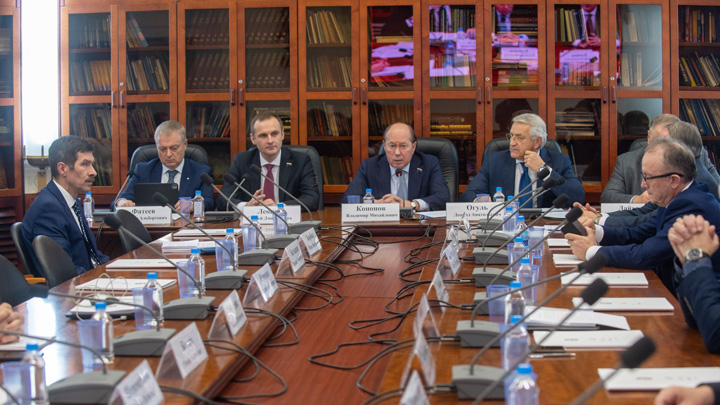
Strategic Session on Healthcare 2025: Priorities, Personnel, Laws took place at Russian Chamber of Commerce and Industry
The Strategic Session on Healthcare 2025: Priorities, Personnel, Laws took place at the Russian Chamber of Commerce and Industry. The event was held as part of the conference programme of Russian Healthcare Week 2025 and was organised by the Russian State Duma Committee on Science and Higher Education in cooperation with EXPOCENTRE.
The discussion was moderated by Vladimir Kononov, Deputy Chair at the Russian State Duma Committee on Science and Higher Education, Chair at the NTI EXPO Organising Committee, and Leonid Ogul, First Deputy Chair at the Russian State Duma Committee on Health Protection.
In his welcoming speech, Vladimir Kononov recalled that the strategic session is being held within the NTI EXPO project, which has been bringing together congresses and trade shows of EXPOCENTRE for ten years: Russian Week of High Technologies, RENWEX, Russian Industry Week, and Russian Healthcare Week. According to him, it is at such events that the science-education-industry-regions link is being built.
Vladimir Kononov placed a special emphasis on the priorities of legislative activity in the field of healthcare and science. He noted that today it is extremely important not just to discuss ideas, but to bring them to solutions. “The legislature is not an observer here, but one of the drivers of change, which is why today's dialogue is so important to us,” he stressed. Vladimir Kononov named the creation of conditions for accelerated implementation of scientific results in clinical practice, improvement of the regulatory framework to support medical science and innovation, as well as the development of a system of personnel training for healthcare, taking into account the needs of regions and high-tech industries, among the key tasks.
“The result of our work should be a specific package of proposals addressed to relevant ministries and committees of the State Duma meaning a document that can be translated into the language of instructions and regulations,” Vladimir Kononov believes. He stressed that the participants of the session represent leading universities, research centres, medical organisations, businesses and regions, which means they are able to formulate balanced proposals for the development of healthcare, personnel policy, and the scientific and technological agenda.
Leonid Ogul, addressing the participants, linked the discussion at the session with the Strategy for the Development of the Russian Healthcare System until 2030, approved a day before. He emphasised the need for legislative support for the priorities of the industry, improvement of personnel policy, as well as acceleration of the introduction of advanced medical technologies and pharmaceuticals. He also noted the importance of expert interaction with the professional community and business, including at the platforms of Russian Healthcare Week and NTI EXPO.
Sergey Leonov, Chair at the Russian State Duma Committee on Health Protection, focused on the personnel agenda and recent legislative decisions in his speech. He recalled that in 2025, the State Duma adopted “unprecedented laws concerning personnel,” including in terms of distance medical education, stricter requirements for licensing educational activities, targeted training, and the institutionalisation of mentoring for young professionals at the legislative level.
Sergey Leonov also touched upon the scientific activities of universities. He pointed to the lack of sustainable funding for university science and the wage gap between practical healthcare and universities, which leads to an outflow of staff from universities. Speaking about innovations, the deputy outlined the problem of two ‘valleys of death’, when promising developments do not reach production and the market, and stressed that these bottlenecks require systemic solutions at the legislative level with the participation of the state, universities, research teams, and business.
Maxim Fateev, General Director at EXPOCENTRE, Head of the Committee on Exhibition, Fair and Congress Activities of the Russian Chamber of Commerce and Industry, spoke about the preliminary results of Russian Healthcare Week 2025. He noted that the Week brought together four trade shows and more than 50 business related events, which welcomed more than 900 companies from 56 regions of Russia and 11 countries.
According to Maxim Fateev, the attendance at the Week’s events shows steady growth. An increase in the audience of about 22% compared to last year is recorded, which indicates the high interest of the professional community in healthcare, medical technology, and medical tourism. He paid special attention to the role of trade shows and congresses as an effective tool for technology demonstration, launching pilot projects, and building a dialogue between business, science, and government.
Nikolay Daikhes, Chair at the Committee on Entrepreneurship in the Healthcare and Medical Industry of the Russian Chamber of Commerce and Industry, Director at the National Research Center of Otorhinolaryngology of the FMBA of Russia, focused in his speech on the challenges of technological independence of domestic healthcare. He recalled that the Committee on Healthcare is, in fact, the only platform that unites representatives of national medical centres, leading universities, and major industrial companies. According to Nikolai Daikhes, about 20% of domestic medical devices and consumables are currently used in the country, while the goal is to reach at least 40%.
Nikolay Daikhes paid special attention to the personnel and innovative aspects of the development of the medical industry. He noted the lack of a postgraduate education system for medical engineers. Speaking about the innovation cycle, Daikhes stressed that a significant number of Russian developments are stuck at the registration stage: on average, it takes from a year to two to bring a domestic medical device to the market, which he called an abnormal situation and a serious challenge for the industry. The Committee's plans include substantive work with projects accumulated in scientific organisations and the Russian Academy of Sciences, assistance in their registration and implementation, as well as the development of international cooperation, and the export of medical services and technologies.
The session was attended by representatives of the Russian Ministry of Health, the Russian Academy of Sciences, leading medical universities and research centers, high-tech companies, and relevant associations.
The speakers discussed key priorities for the development of Russian healthcare, the training of medical personnel at all levels, mechanisms for reducing the gap between scientific development and the introduction of technology into practice, issues of financing medical science, digital transformation of the industry, as well as the export of medical services and high-tech medical products.
Following the results of the strategic session, it is planned to prepare a package of proposals addressed to relevant ministries and parliamentary committees. They will become the basis for further work on improving the regulatory framework and tools for supporting projects in the field of healthcare, personnel policy, and the development of medical technologies.
Press Service, EXPOCENTRE AO